The Maintenance Worker’s Checklist: What to Expect in Your First Week at a New Company
Starting a new maintenance job comes with a lot to learn. Every facility has its own equipment, safety procedures, maintenance routines, and way of getting things done. Even experienced maintenance technicians need time to understand how a new operation works.
The good news is that you don’t need to know everything on your first day. Your first week is really about learning the facility, understanding expectations, getting familiar with critical equipment, and showing your new team that they can count on you.
Whether you’re starting a maintenance position in North Carolina, South Carolina, Georgia, or elsewhere, this checklist can help you make the most of those important first few days.
Explore Maintenance Job Opportunities
Before Your First Shift: Get the Basics in Place
A smooth first day often starts before you arrive.
Confirm where you need to report, what time your shift begins, and whether you need to bring specific tools or personal protective equipment (PPE). If the company has provided safety information, training materials, or facility policies in advance, take some time to review them.
It’s also worth asking about access requirements. Some facilities require badges, safety orientations, equipment certifications, or additional training before employees can enter certain areas or begin working independently.
If you’re starting your position through Accurate Staffing and aren’t sure what you need, reach out to your recruiter before your first shift.
What to Confirm Before Day One
- Required PPE and safety equipment
- Work schedule and reporting location
- Badge or facility access requirements
- Tools you’re expected to bring
- Safety orientation or training requirements
- Access to maintenance software or work-order systems
A little preparation can help you spend less time figuring out logistics and more time learning your new role.
Day 1: Learn the Facility and Meet Your Team
Your first day doesn’t have to be about proving how much you know. Focus instead on understanding how the facility operates.
Meet your supervisor and the technicians, operators, and other employees you’ll work with regularly. Ask how maintenance requests are submitted, which equipment is considered most critical, and what issues the team is currently watching.
If possible, spend time with an experienced technician. Walking the floor together can give you context that equipment manuals and work orders alone won’t provide.
Pay attention to how the team communicates, how priorities are handled, and what happens when an unexpected equipment issue occurs.
Questions Worth Asking on Your First Day
- Which machines or systems are most important to production?
- What maintenance problems occur most frequently?
- How are work orders assigned and prioritized?
- Who should I contact when an issue affects production?
- Are there upcoming preventive maintenance tasks I should know about?
- Where are tools, replacement parts, manuals, and safety equipment located?
You don’t need to memorize every answer. Take notes and build your knowledge as you go.
Days 2, 3: Get Familiar With the Equipment
Once you understand the basic workflow, you can start getting more familiar with the equipment you’ll maintain.
Depending on the facility, that could include conveyors, motors, pumps, gearboxes, control panels, sensors, production machinery, or other mechanical and electrical systems.
Review recent maintenance records when they’re available. They can help you identify recurring problems, recently replaced components, and equipment that may need closer attention.
This is also a good time to learn the facility’s preventive maintenance schedule.
What Should You Check?
Your responsibilities will depend on your position and the facility, but common areas may include:
- Lubrication schedules
- Belt and chain condition
- Motors and electrical connections
- Sensors and controls
- Pumps and mechanical components
- Unusual vibration, noise, or temperature changes
- Preventive maintenance schedules
- Replacement-part availability
Follow the facility’s procedures and your assigned responsibilities when inspecting or servicing equipment. When something doesn’t look right, document it and communicate it to the appropriate supervisor.
Keep Good Maintenance Records From the Beginning
One habit that can make your job much easier is documenting your work consistently.
Don’t wait until the end of the week to remember what happened. Record inspections, repairs, parts used, unusual equipment behavior, and any follow-up work that may be needed as you go.
Good documentation helps the next technician understand what happened and gives supervisors a clearer picture of equipment condition.
It also helps you avoid repeatedly troubleshooting the same issue from scratch.
Learn More About Skilled Trades Careers
Days 4, 5: Start Building Your Routine
By the second half of the week, the facility should begin to feel more familiar.
You may start handling more tasks independently, depending on your experience, training, and the company’s procedures. Continue asking questions when you need clarification, but also begin developing a routine for checking equipment, completing work orders, and documenting your work.
You may also notice small opportunities for improvement. Perhaps a frequently used replacement part is difficult to locate, a maintenance record needs updating, or a recurring equipment problem deserves closer attention.
You don’t need to redesign the maintenance program during your first week. Identifying practical improvements and discussing them with your supervisor can be a much better place to start.
Before the Week Ends, Review What You’ve Learned
Your first Friday is a good opportunity to organize your notes and identify what still needs your attention.
Consider reviewing the most important equipment you encountered, open work orders, upcoming preventive maintenance tasks, replacement parts that may be needed, and any questions you still have.
A quick conversation with your supervisor can also help confirm that you’re focusing on the right priorities going into week two.
Your End-of-Week Checklist
Before wrapping up your first week, make sure you can answer these questions:
- Do I understand the facility’s main safety procedures?
- Do I know which equipment is most critical?
- Do I understand how work orders are assigned and documented?
- Do I know who to contact when I need help?
- Am I familiar with upcoming preventive maintenance tasks?
- Have I documented the work and observations from my first week?
- Do I know what my priorities are for next week?
If you can answer most of these confidently, you’ve already built a strong foundation.
Common First-Week Mistakes to Avoid
One of the easiest mistakes to make in a new maintenance role is trying to move too quickly.
Every facility is different. A repair method or process that worked at your previous company may not be the procedure used by your new employer. Take time to understand the equipment, safety requirements, and established maintenance processes before making assumptions.
Another common mistake is failing to document small issues. Something that seems minor during an inspection can become useful information if the same problem appears again.
Finally, communicate. If you’re unsure about a procedure, priority, or equipment condition, asking the right person is usually better than guessing.
Talk With an Accurate Staffing Recruiter
Skills That Can Help You Grow in Maintenance
Your first week is only the beginning. As you become more comfortable in the position, look for opportunities to strengthen skills that can help you take on greater responsibility.
Depending on your career path, useful areas to develop may include preventive maintenance, electrical troubleshooting, mechanical systems, HVAC, root-cause analysis, industrial safety, PLCs, and equipment diagnostics.
The more you understand the systems around you, the more prepared you’ll be when something doesn’t go according to plan.
Frequently Asked Questions About Starting a Maintenance Job
What should I bring on my first day?
- Start with whatever your employer or recruiter has specifically requested. That may include required PPE, identification, certifications, tools, or other documentation. If you haven’t received clear instructions, confirm the requirements before arriving.
How quickly should I start documenting maintenance work?
- From the beginning. Follow the company’s maintenance reporting procedures and document completed work, observations, repairs, and parts used when required.
What should I do if operations and maintenance give me different instructions?
- Safety and established facility procedures should remain the priority. If instructions conflict, speak with your supervisor or the appropriate site leader rather than making assumptions.
How can I make a good impression during my first week?
- Be dependable, arrive prepared, follow safety procedures, ask thoughtful questions, communicate clearly, and complete your assigned work carefully. You don’t have to know everything immediately. Showing that you’re willing to learn and can be relied on matters.
What should I focus on learning first?
- Start with safety procedures, critical equipment, work-order processes, preventive maintenance expectations, and communication protocols. Once you understand those fundamentals, you can gradually build deeper knowledge of the facility.
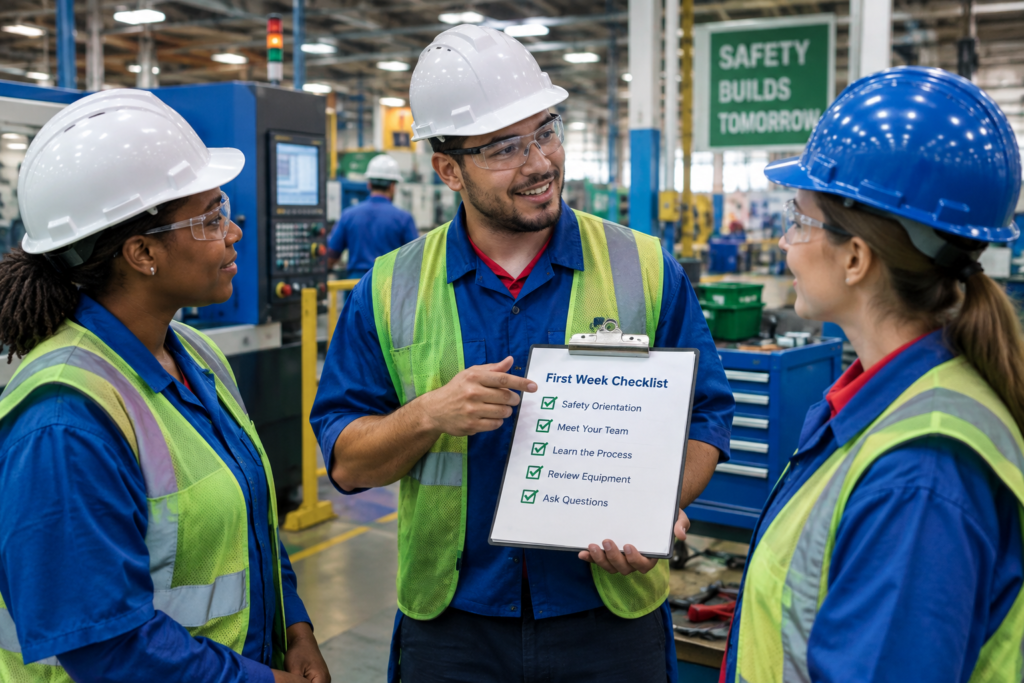
A Simple 5-Step Plan for Your First Week
If everything feels like a lot to remember, keep your first week simple:
- Learn the safety requirements: Understand PPE, lockout/tag out procedures, facility rules, and emergency protocols.
- Identify critical equipment: Learn which machines have the greatest impact on production and where recurring issues happen.
- Understand the maintenance process: Find out how preventive maintenance, work orders, repairs, and documentation are handled.
- Keep good records: Document your work and important observations according to company procedures.
- Prepare for week two: Review what you learned, clarify remaining questions, and understand your upcoming priorities.
The goal isn’t to master the entire facility in five days. It’s to finish your first week with a clearer understanding of the operation and a solid foundation for the weeks ahead.
Ready for Your Next Maintenance Opportunity?
A strong first week can help set the tone for your entire assignment. Stay focused on safety, learn the equipment, communicate with your team, and build good maintenance habits from the beginning.
If you’re looking for maintenance, industrial, skilled trades, or related opportunities, Accurate Staffing can help connect you with employers looking for dependable talent across North Carolina, South Carolina, Georgia, and surrounding markets.
For employers, having the right maintenance professionals in place can make a major difference in keeping equipment and operations moving. Accurate Staffing can help you find qualified candidates based on your facility’s workforce needs.